

Lina Voss had not planned to become whatever it was she had become, because when she had planned her life there had not yet been a word for it.
There was a word on the dropdown, technically. There were several. None of them fit, which was a problem she had stopped expecting to solve and started expecting to carry. She had been a lawyer, a fourth-year associate at a mid-sized firm in Boston, doing transactional work she was good at and did not love, back when careful written work was scarce and expensive and a person could build a whole life on the scarcity. Then the transition came for the scarcity. She had seen it coming the way you see weather: she’d taken the two-week intensive at law.MIT.edu in the summer of 2026, on a whim and a friend-of-a-friend’s recommendation, and come out of it rewired. A year later, when the firm’s billable hour folded and the reorganization declined to include her, she already had the people and the muscle to fall sideways into something else. The something else was a company. She ran what they called specifications and what was really judgment: deciding, in language a generator could not misread, what a thing was actually supposed to do.
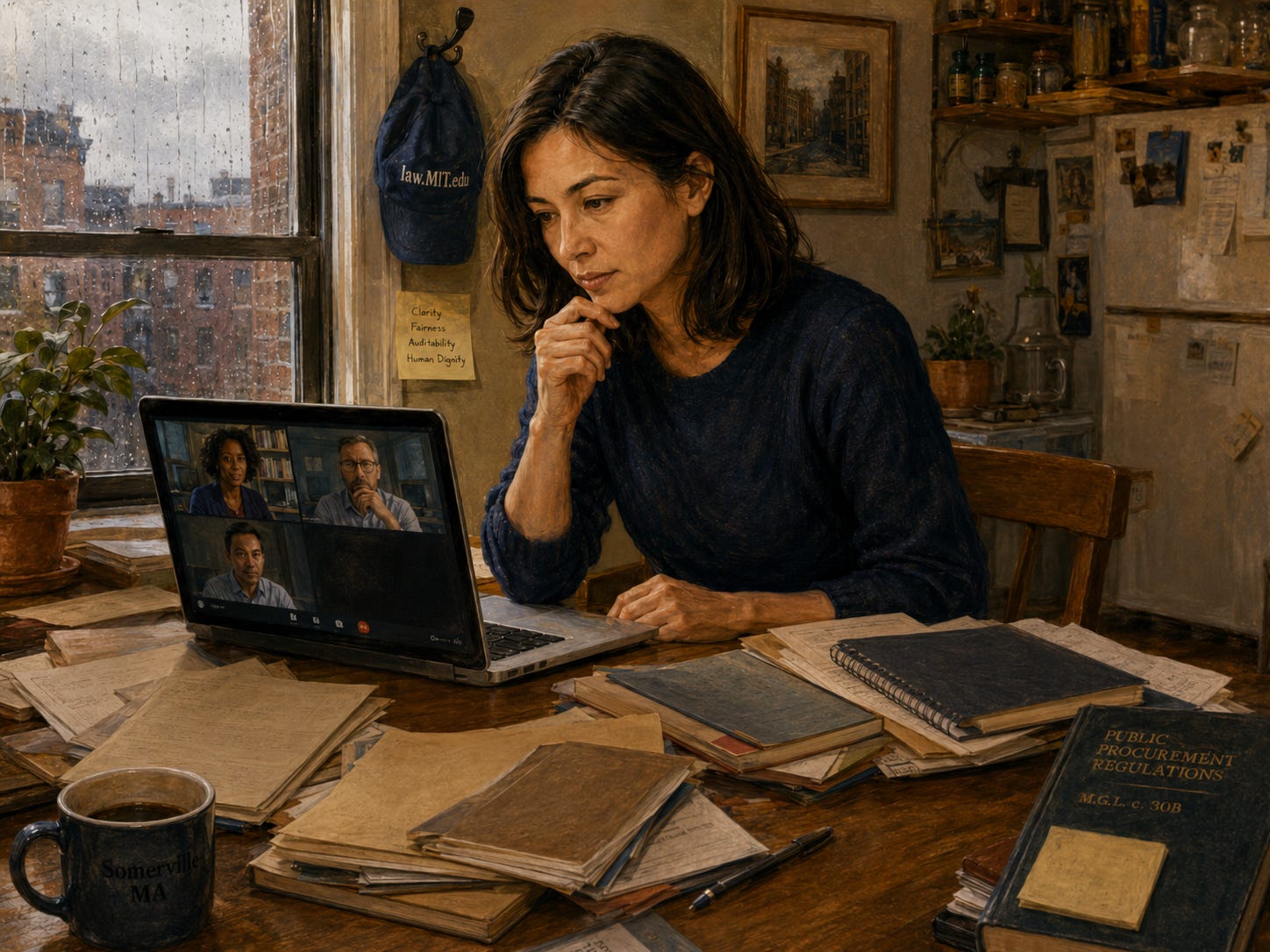
It was a Tuesday in March, raining, and the day had three rooms in it. Work in the morning. Bernal Glen town meeting at six. Game night at Felix’s at half past eight. She drank yesterday’s-recipe coffee standing at the counter, watching the rain bead and run on the window over the sink, and at ten of eight she sat down and brought up her work harness. Which is to say she spawned an instance with the company’s approved models, their shared context, their tool permissions, their rules of engagement, and the accumulated layer of her own preferences the others had started calling her “voice”: a thousand small defaults about formality, hedging, citation, and how hard to push on a bad idea. It was not the same as the civic instance she’d run later, inside the town’s overlay. It was not the same as the loose, profane thing she’d spin up at Felix’s. People said “my agent” as though it were one creature. It was never one creature. It was a posture the room required, and you put it on at the door.
A message was waiting from Theo, sent the night before. Thank you again for the plugin surgery, you’re a wizard. The legal feed is glorious. Drinks soon, on me. Theo had been her way into half her life here. It was Theo who’d dragged her to her first game night, her first month in Bernal Glen, back when she knew exactly two people in town and one of them was Walt. She smiled at it, sent back a thumbs-up and anytime, it’s a five-minute job for anyone who’s done it once, and forgot about it, which she would have cause to remember forgetting.
At eight, her Meet pinged.
I. Work
There were four of them: June Park, who had designed everything anyone loved about the product and a few things people hated for reasons she could defend at length; Owen Diaz, who ran business and had the flat calm of a man on his third startup and determined that it not end like the first two; Anika Patel, who ran operations and, in practice, told everyone when their idea was bad; and Lina, who today ran the Rules Engine.
The job was a state procurement. The Office of Digital Services wanted a new constituent-services platform, five interoperable modules with hard interface contracts between them. The rules had changed since Lina’s lawyer days. You did not bid a procurement now with a document of promises. You bid it with a thing that ran. The state defined the project and published the scoring rubric, and every team built the working bones of it and submitted them into a secure evaluation room. Your own agent could go into that room and test your build against the rubric and bring back verified results; it could not see or carry out one line of anyone else’s code. Above a rubric cutoff, the top band of submissions split a fixed pool (twenty percent of the project’s expected spend) in equal shares, ties going to whoever had submitted first. The single highest build won the actual contract to finish and deliver.
It had grown up around a problem the new world had handed every large buyer at once: anyone could generate code now, oceans of it, all of it plausible, so prose had become worthless as a filter and you could only tell a real team from an expensive imitation by what ran. So the state made everyone build the bones and let the room score what was real. The pool rewarded the teams who were good not at making code but at making the right code: the ones who could take a sprawling, contradictory ask and render it into something that did the thing and could be held to it, which was, Lina had noticed, the skill the whole economy was quietly reorganizing itself around. And it kept money moving, spreading a real payment across a band of small shops so that the act of competing fed a working ecosystem and kept human judgment employed and paid. It was one of the levers the post-transition governments had learned to pull deliberately, against a world that had ended up with a glut of capability and a shortage of the wisdom to point it anywhere worth going.
The catch was in the size of the share. For a four-person shop bidding two of the five modules, the pool cut came out to roughly break-even: enough to make building the bones rational, not enough to live on. You did the work, you cleared the band, you got your rent back and the dignity of having shipped something real. To actually make money you had to win: take the contract, finish, deliver. And between here and there stood the red-team.
They were bidding two of the five: UI/UX, June leading, and Rules Engine, Lina’s. The bid was due Friday, close enough now that the days had edges.
“Run me the red-team result one more time,” Owen said.
Anika ran it. The agents had worked it overnight, the third full adversarial pass on their bones, every top-of-the-line frontier model they could point at it, cycle after cycle, and it came back, like the two before it, with breaking changes. Not catastrophic. Subtle. The kind a careful human misses and a generator never does, the kind that, shipped and won, would cost real remediation in the first sixty days.
“We can’t run it again,” Anika said. “The tokens alone.” She did not have to explain. The passes ran the most expensive models in existence, many of them, many times over, and the firm’s whole survival on a bid like this rested on keeping the cost of the eligibility build rock-low, because the break-even pool cut left no slack, and every cycle they burned was a cycle the pool would never pay back.
“We can run it again,” Owen said. “We can’t afford to. Different sentence.”
Nobody argued, because Owen was right about money in the annoying way he was usually right. But it was worse than the tokens, and they all knew the worse part. The first red-team had caught the big architect-level faults, the load-bearing ones, the ones that sink you. The trouble was that the second full pass had still come back with a large pile: not the architecture now, but a deep seam of smaller breaking changes. And a seam that deep, two passes in, meant the seam was effectively bottomless. You could go back to that well forever and keep hauling up defects, because a specification was an infinite surface and the world underneath it never stopped moving. Which left two ugly shapes. Either they kept paying to find problems until the finding sank the bid before they ever submitted. Or they submitted, won, and met the rest under contract, where every legitimate breaking change had to be walked through the state’s review, and the state was a bureaucracy that could volley a single change back and forth ten times before it signed, each volley a fresh spend of time and tokens. The scarce resources of the new economy were time and tokens, and if they did this wrong, the prize was the privilege of going broke slowly.
“Option B,” June said, who hated Option B but believed in saying every option out loud at least once.
Option B was the security shop. They’d been circling it a week: a six-person outfit in Providence, almost all former defensive-security engineers, who sold something they branded Lightning Red-Teams: full adversarial review and patch in under four hours, guaranteed. Their public work was very good. Their pricing was opaque, as security pricing always was. And they had a bid in on this same procurement, on Security/Identity, one of the three modules Lina’s team wasn’t touching.
Four hours, guaranteed was the phrase that mattered. It turned the bottomless well into a wall: a known cost, a known stop. What was bleeding Lina’s team was that their own review had no floor; the Providence shop sold a floor, and sold it good and fast, which was the whole reason a person swallowed their pride and shared a contract.
The shape of it was clean enough to sketch on a napkin, and Lina’s agent had already sketched it, posting a comparison to the shared canvas and then going quiet. Security/Identity had hard interfaces into both UI/UX and Rules Engine, exactly the surface where bad specs bred the breaking changes their red-team kept flagging. If the Providence shop owned Security/Identity and ran continuous adversarial review across those interfaces, Lina’s team’s remediation dropped toward nothing. And the favor ran both ways, which was the part that made it a deal and not a rescue: the security shop were brilliant at threat models and could not, on their own, win a module bid in a regulated public-sector environment, because they had no UI story and no story at all for mapping a rules engine onto the tangle of statute and procedure a government actually ran on. That second thing was Lina’s. That was the nameless work: taking a body of law and obligation and turning it into something a machine could execute without lying about what the law said.
“They’ll say yes,” Owen said. “We’re their UI and their legal story. They’re our security story. Together we’re a whole bid and apart neither of us is.”
“So why hasn’t anyone called them,” said Anika, already typing.
“Because we’re founders. Founders are bad at sharing.”
June laughed, the first laugh of the call. They walked it once around the table first: could they just buy services from each other, audit-for-hire, no formal team-up? They could. They decided not to. A one-time teaming agreement was cleaner than two invoices and a handshake, and cleaner mattered when the thing you were submitting was a contract for the state to read. So Lina did the part that was hers. She drafted the teaming terms while the others talked: scope, roles, rights, obligations, the explicit one-time nature of it, and a light pre-agreed mechanism to do it again later without renegotiating from zero. Old muscles. The firm had paid her to anticipate every way a counterparty might misread a sentence; the work now was the same muscle pointed at a different reader, half of them human and half of them not.
Anika opened a line to Bram Costa, who ran the Providence shop, and forty minutes later there were nine people on the call. It was no longer a Meet, because Bram’s firm ran Microsoft Teams and only Teams (”security posture,” he said, with the wince of a man who knew how it sounded), so Lina found herself in the soft gray interface she hadn’t touched in eighteen months, hunting for the share button. The two harnesses inspected each other at the threshold, flagged four permission mismatches, and resolved them between themselves before anyone reached for coffee. Bram’s agents were built tighter than hers: harder sandboxes, louder logging, a persona that would not emit code without first emitting a written threat model. When her agent and his first coordinated on a draft interface, she watched her own go slightly more formal to match, more numbered, fewer hedges, and thought, not for the first time, that a great deal of her workday now consisted of watching the agents find each other’s register while the humans made small talk about the weather and the Patriots.
They made the small talk. Bram was funnier than his website. June liked his lead designer, who’d known June’s old roommate at Pratt. They worked the terms in ninety minutes, the agents drafted the joint bid in twenty more, and by half past eleven they had a combined package that scored eleven points higher on the rubric and no longer needed a fourth red-team pass, because Lightning Red-Teams was now the red team.
The submission portal wanted a name in a required field: Lead of Record. The dropdown offered Engineer, Architect, Counsel, Project Manager, Other. She had built the rules engine’s logic and written the contract that made the alliance real and mapped a thicket of regulation onto something that would run; there was no word on the list for the sum of that. For a moment the cursor hovered at Counsel, and she felt the pull of it: the old self, the safe one, the lawyer in the room, the role that had a bar number and a known shape. But she wasn’t the lawyer for the business anymore. She was the business. She moved the cursor up and chose Architect, which was also not quite right. It would read to anyone as the software kind, which sold the other half short, but it was the truer wrongness, the forward-facing one, and she submitted before she could litigate it any further.
Her phone lit while she was closing the laptop. Her brother. congrats on the bid!! mom told me. but seriously what do you even DO there. like what’s the actual job. Ken built guidance systems for a defense prime, a company so large and so far up the pre-transition slope that the transition reached it as rumor; he had an engineering degree and a badge and a title that had meant the same thing for forty years, and he asked the question with love and without any idea that it landed like a hand on a bruise. She started three answers. I’m a specifications architect. True and meaningless. I do legal engineering. A phrase she half-believed and couldn’t say to Ken. I decide what software is supposed to do and make sure it can be held to it. The closest, and still not it.
She wrote lol I’ll explain at Easter and put the phone face down, and the question sat there unanswered, which was, she was coming to understand, simply the shape the question had. The work had never been more real. It had never had less of a name. She picked up the law.MIT.edu hat off the hook by the desk (Summer 2026 stitched under the wordmark, the brim gone soft), turned it over once in her hands the way you touch a thing to remember it’s yours, and hung it back up.
She ate lunch standing at the counter, watching the rain. She walked. She read the warrant for Bernal Glen’s spring meeting a third time, because Article 14 was the kind of thing she’d have written a memo on in the old life and the habit of preparing outlived the job that paid for it. At a quarter to six she pulled on a raincoat and walked down to the Market, the little grocery-and-cafe on the corner that did a respectable flat white and a better soup, to eat something before the meeting, because Bernal Glen held its town meeting online now and there was a particular loneliness to legislating on an empty stomach.
II. Civic
She was wrestling her dripping coat onto the crowded rack by the cafe door when a voice behind her said, “They moved the brook article up to fourteen. They’re going to try to run out the clock.”
It was Walt. Walt was somewhere past seventy, had thrown himself into town meeting the year he retired the way other men took up sailing, and had, Lina’s first year in Bernal Glen, taken her quietly under his wing without ever once making her feel taken. She’d shown up to her very first meeting knowing nothing: not what a warrant was, not how an article became a motion, not how a motion became an amendment, not why anyone would sit in a gym on a weeknight to argue about a culvert. Walt had explained all of it in the low, unhurried way of a man who assumed you were smart and simply hadn’t been told yet, and she had loved that meeting, and then made associate, and not come back for years. She’d bought a mug at the Market that first night, on the walk home, for no reason except that the night had felt like belonging and she’d wanted an object to hang the feeling on.
“Walt,” she said, and meant it. “How bad?”
“Friends of Meadow Brook have the votes to be annoying and not the votes to win clean. So they won’t try to win clean.” He said it without heat, the way he said most things. “Watch the amendments. The trouble’s always in the amendments. Get something to eat. You look like a person who read the comprehensive plan again.”
“I read the comprehensive plan again.”
“I know. It’s why I worry about you.” He patted her shoulder once and shuffled off toward his usual corner table, and she felt the specific warmth of being known by someone who’d known her before she was anyone here, a warmth that had nothing to do with being prepared, because Walt had never once been impressed by preparation. He was impressed by showing up. He’d told her so, her first year, and she’d thought it was a small thing to say and had since decided it was nearly the whole thing.
She ate her soup. At six she carried the mug (her mug, the Bernal Glen mug) back up to the apartment and set it by the laptop, and the town’s overlay began its handshake.
Bernal Glen had run its town meeting online for two years now. The form was older than the town’s pavement. Open meeting, any registered voter could speak and vote, and like most very old things it had survived by absorbing procedure, so that what happened on the screen was still Robert’s Rules underneath, still motions and amendments and the moderator’s patient gavel, just with the room dissolved into eighty-seven squares of light. The town that had dissolved the room had also handed every voter the overlay that made the dissolving fair: a town-supplied module that read the warrant, surfaced the relevant by-law, drafted a motion into proper form, flagged a procedural opening, and logged every move it made into an audit trail the clerk and the moderators could inspect for thirty days. The point of giving it away was leveling. Before, the residents who could afford the time to prepare (the retired, the lawyerly, the obsessive) had owned the floor. Now everyone arrived equally briefed, the floor belonged to whoever had the better argument rather than the better afternoon, and a man who’d worked a double could still walk in and hold his own.
Which did not, Lina had learned, end the games. It only moved them inside the frame. People still schemed; they schemed in proper form now, with citations.
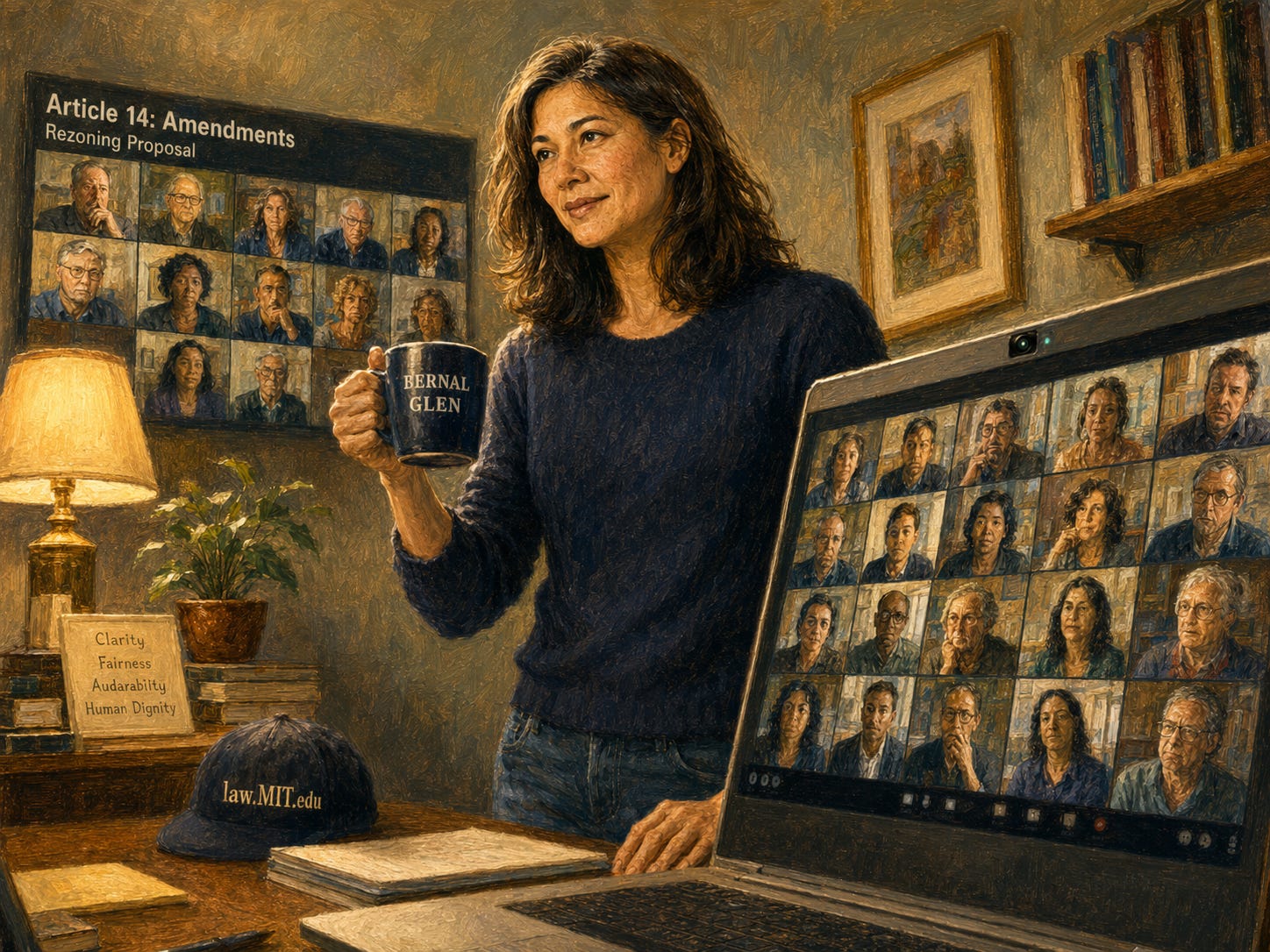
The overlay summarized Article 14 for her in ninety seconds: a proposal to rezone six acres on the east side from residential-agricultural to mixed commercial, to let a regional grocery cooperative build a small store. Planning Board for, Select Board for, Conservation Commission against, and against them too the residents of the three streets nearest the parcel, organized as Friends of Meadow Brook, after the brook that crossed the eastern edge, the brook that ran down out of Merritt Lake and that the Commission’s hydrologist had testified would take on more stormwater than it should under the plan. The overlay gave her a four-page brief, a list of six places the supporting documents contradicted each other, and three questions she might ask if she chose to be recognized. The same work, done by a careful human at her old rate, would have run the town six thousand dollars, times the eighty-seven voters logged in tonight: a quantity of civic preparation no town this size had ever been able to buy and now could not stop itself from having.
This was the part she found genuinely beautiful and, some evenings, unbearable. Everyone arrived prepared. The debates were better, faster, more substantive, and somehow less satisfying than when half the room had been winging it, as though the old meetings had partly been a performance of effort, the visible labor of caring, and when the labor went cheap the performance went hollow and left only the decisions, naked on the table. She had never found a way to say this aloud that didn’t sound like she missed being condescended to by retirees. She suspected the truth underneath it was the same question her brother’s text had left unanswered: when the preparing is free, what exactly is the human for? She did not have the answer. She had only noticed that the question followed her from room to room and wore a different face in each.
The debate went the way these went. The Planning Board chair made the case. The Commission made the objection. A Friends of Meadow Brook representative spoke her three minutes. The co-op’s project manager took questions from his office in Greenfield. Then a resident on Hill Road moved to amend: strike the plain rezoning, replace it with conditional approval contingent on the co-op funding a stormwater retention easement upstream, sized to a twenty-five-year storm. It was, in Lina’s professional read, the compromise that actually worked; it answered the hydrologist, let the project live, cost the co-op maybe nine percent of the site budget, steep and survivable. Her overlay flagged it procedurally clean and substantively serious. She thought it would pass.
Then the Friends of Meadow Brook representative moved to amend the amendment: size the easement to a hundred-year storm instead.
And Lina, watching the three engineering citations bloom in the assist column beside the motion (neat, specific, exactly load-bearing enough) felt the floor of her stomach drop, because she knew those citations. Not their content. Their grain. They had the particular formatting and the particular reach of a small public-interest legal-data service she’d relied on since the firm took back her research login: the free access-to-justice tier of a scrappy outfit that put real legal and technical research in the hands of people who couldn’t pay for the expensive feeds. She knew the grain of it because she lived in it. And she knew, with a cold and complete certainty, why she knew it here. Because last week Theo had asked her, friend to friend, to help him wire that exact feed into his town overlay, an auxiliary rules-engine plugin, a five-minute job for anyone who’d done it once, and she had done it gladly, a wizard, anytime, and thought no more about it than you think about lending a ladder.
Theo lived on Hill Road. Theo came to game night. And Theo, she understood now in one long unspooling second, had not wanted deeper legal research to be a better citizen. He had wanted it to build this: a hundred-year easement that would cost the co-op not nine percent but forty, which would not improve the brook, which would kill the project, which was the entire point and the one thing the Friends could never say out loud because saying it would lose them the room. It was a poison pill. It was procedurally immaculate. The overlay’s integrity check sat silent beside it, because the integrity check caught prompt injection and duplicate ballots and coordinated inauthenticity, and this was none of those. This was a legitimate motion, beautifully made, with a lie for a heart, and the only thing in the room that could see the lie was a human being who knew the watershed, knew the numbers, and knew, to her particular sickness, exactly whose hands had built it, because they were partly hers.
She sat for a moment with the mug warm against her palm.
Then she pressed to be recognized. The moderator called her name. She picked the mug up in her right hand, the way she always did, so that BERNAL GLEN faced the camera when she drank (a small nerd’s pride she’d never explain to anyone and never stopped enjoying, the town’s name on her hand on eighty-odd screens, I am from here, this is mine too), and she stood, and she made the case in about seventy-five seconds and without notes: that a hundred-year design on a parcel this size in this watershed sat well past the point where cost bought safety, that the engineering literature said so plainly, that the twenty-five-year easement answered the real concern and the amendment-to-the-amendment answered a different and unspoken one, and that the body would do well to vote it down and vote the honest compromise up. She sat. Two others said briefly the same. The amendment to the amendment failed by a comfortable margin. The original amendment passed. Article 14, as amended, passed with twenty-three votes to spare, and the co-op would have its store, and Meadow Brook would have its easement, and she had won.
She had won using the literature anyone’s overlay could now reach, including the reach she’d handed Theo herself, which he’d turned into the weapon she’d just disarmed with the same tool. She had been on both ends of the thing. The overlay had leveled the field so thoroughly that the only edge left in the room had been a human one: knowing the brook, and knowing the man. She set the mug down. The screen moved on to Article 15. She did not feel like a citizen who had served her town. She felt like a person who had just realized a friend had used her, and beaten him for it, and would now have to decide what to do with the rest of an evening that contained, at half past eight, that same friend.
She closed the laptop. She washed her face and stood a second looking at nothing. She put four beers in a canvas bag, and then stood with two more in her hand, going back and forth. Theo might not come. After the article, after the way it had gone, maybe he wouldn’t, and she found she had no idea which. She didn’t yet know how deep the thing ran; she only knew she didn’t want to walk down those stairs having already decided he wouldn’t be there. She put the two in the bag, for Theo, in case.
III. Play
There were five of them at Felix’s, and one empty chair.
Felix taught middle-school math and was the only one of them with real strategic instinct. Marta ran the back office of a veterinary clinic and was funnier than the rest of them put together. Sam did something for the city that no one had ever made him explain. Priya was a postdoc in atmospheric science, six months into the group and a month into dating Sam, a development they had all been instructed to find unremarkable and did. And the sixth chair, the one by the window with the good light, was Theo’s chair, and Theo was not in it.
“Is Theo coming?” Marta asked, setting out the pizza, and the question landed in the small particular silence of a group that has each separately checked the same thread and gotten the same nothing.
“He said he might have a thing,” Sam offered, which was what people said.
“He had a town thing,” Lina said, and heard how carefully she said it, and watched Marta hear it too (Marta, who missed nothing) and watched her decide, with the generosity that was the truest thing about her, to let it go for now. “We were on opposite sides of an article. It got a little sharp.” All true. None of it the truth, which was sitting in Lina’s gut where the soup had been, and which she was not going to set on Felix’s coffee table next to the pizza. It stung because it had been real: the drinks-soon, the wizard, the ladder lent without a thought. You could be used by someone who also, genuinely, liked you. That was the part that didn’t resolve. She let it go too, for now, and reached for a slice, and the night closed warmly back over the empty chair the way water closes over a stone.
Except that Priya, who read every town warrant the way she read papers, methods first, said, “The brook one? With the easement?” She wasn’t needling; she was reaching for a slice. “Twenty-five-year storm. Huh.” A small pause, pointed at no one. “You know the thing about recurrence intervals. They’re not what they used to be. We redraw the curves every couple of years now, and they only ever move in one direction.” She said it the way she said most things from work, lightly, a fact set down on the table like a napkin, and the conversation moved on to whether Felix had ordered enough pizza.
It stayed with Lina maybe four seconds longer than it stayed with anyone else. She had stood in front of eighty-seven squares of light and said the engineering literature says so plainly, and it did. Today. She filed that next to the other things she was not setting on the coffee table, and took a second slice she didn’t want.
The game tonight was the strategy one. There was a rotation. Last month had been the narrative RPG, the long D&D-style campaign, where Marta had spent six hours trying to talk her way past encounters rather than fight them, brokering an agent-mediated peace with a band of goblins that Felix maintained had set a two-year high-water mark for absurdity. And next month was the Prototype Jam. The Jam had grown out of what used to be the local Code for America and Legal Hackers chapters, two civic-tech meetups that had quietly merged and softened over the years into a loose standing collection of civic-minded tinkerers; you showed up, you picked a Quest off the current board (a live list of Requests for Projects posted by area non-profits, the town governments, the public schools, the food pantry, whoever had a real problem and no budget) and the whole game was that you solved it, built it, and shipped it, all of it, in one big-gulp overnight jam. Lina loved the Jam with a slightly embarrassing intensity. In the Code for America days, Felix liked to say, a thing like this would gather a hopeful team around a worthy problem, meet every Tuesday for four months, and ship, in the end, a logo and a sense of disappointment. Now you shipped the thing before the pizza got cold. The rotation worked.
The strategy game ran mostly through the agents; the humans set goals and broad lines, the agents ran the move-by-move, the supply math, the small tactical calls the humans had stopped finding interesting and the agents had, over a year, gotten genuinely good at. What the humans did was talk, and occasionally override.
Lina set her laptop on the coffee table and took the dice out of her bag: seven blue polyhedrals gone soft at the corners, bought at a comic shop in Somerville the summer after the bar, when she was twenty-six and needed something to do with her hands on Thursdays that wasn’t dreading Friday. They had no function in the strategy game. The strategy game had no dice. They were a house rule Felix had written in month two, after a bitter argument about whether you could trust the agents’ probabilities: any human player may at any time move to resolve any decision by physical dice; if seconded, the agents are bound by the roll. It had been invoked four times in a year. The point had never been the rolling. The point was that the rolling was possible: that somewhere under all the optimization there was a trapdoor marked human, and you could drop through it whenever you needed to remember the trapdoor was there.
She set them on the table where everyone could see.
“We are not using the dice tonight,” Felix said, pointing at her without looking up from his board.
“You don’t know that,” Lina said.
“I would like to formally request that we use the dice tonight,” Sam said, with great solemnity, and Priya laughed and reached for a slice of pizza, and Felix groaned, and the dice sat there in the middle of the table like a small blue idol to the proposition that a human should be allowed to do something stupid on purpose.
They played two and a half hours. Lina’s nation built an alliance with Marta’s and they spent the second hour quietly dismantling Felix’s, who saw it coming at minute eighty and spent forty minutes trying to talk his way back to even: moral appeals, what he called the long game, what Marta called, with love, “Felix losing.” And it was during the long slow collapse of his position that Felix said the thing.
“You know what’s funny,” he said, not really to anyone, moving a piece his agent had told him to move. “I don’t think I lost that. I think I got out-computed. You two had better alliance math. Lina’s harness and Marta’s harness shook hands at minute three and the rest was just.” He waved a hand at the board. “Execution. I used to lose because I made a bad read. I miss making a bad read. I miss when we were all bad at this.” He said it lightly, and it was not entirely light. “There’s a guy at school runs a Friday night. No agents, no phones, you play out of your own dumb head and you lose because you’re dumb. I keep almost going.” He shrugged. “Anyway. Your move, betrayer.”
Nobody said anything clever, because there wasn’t anything clever, and the thing about Felix was that he hosted the night he was quietly mourning, every month, on purpose, because he loved it more than he missed it. But only just, and the only just was new, and they had all heard the only just, and the dice on the table looked, for a second, less like a joke and more like a splint on something that was going to need more than a splint.
Lina thought about the other guy. Not Felix’s school guy, the one from the building two doors down who’d invited her, twice now, to a different kind of night: fully mediated, agents in everything, nothing real in the game until it had passed through your agent first, even with everyone in the same room breathing the same air. Laudable, maybe, a purist of the new thing, all the way in, no nostalgia, no trapdoor. Or a small bad sign about a person, to want even the dice taken out of his own hands. She couldn’t tell, and she noticed she wanted to find out, and she let the question hang there next to the others, a whole evening of trapdoors she wasn’t dropping through tonight.
Late in the second hour, Marta proposed the dice. Her reserves: north front or hold them in the capital. Both agents had run it; both came back a hair off fifty-fifty; both, politely, recommended holding.
“Dice,” Marta said. “Two of them, add them. Nine or up, I send everyone north.”
“That’s almost certainly wrong,” her agent noted in the side panel, in the level way they noted things, expected losses run thirty-plus percent over the hold line.
“I know exactly how wrong it is,” Marta said. “That’s not the question.” She scooped up two blue dice, kissed her fist around them, reared back, and as they left her hand she threw her whole body into the table and bellowed, at a volume that would bring a text from the downstairs neighbor within the minute, “LEEEEEROYYYY JENKINSSSS!!!“
The dice came up nine.
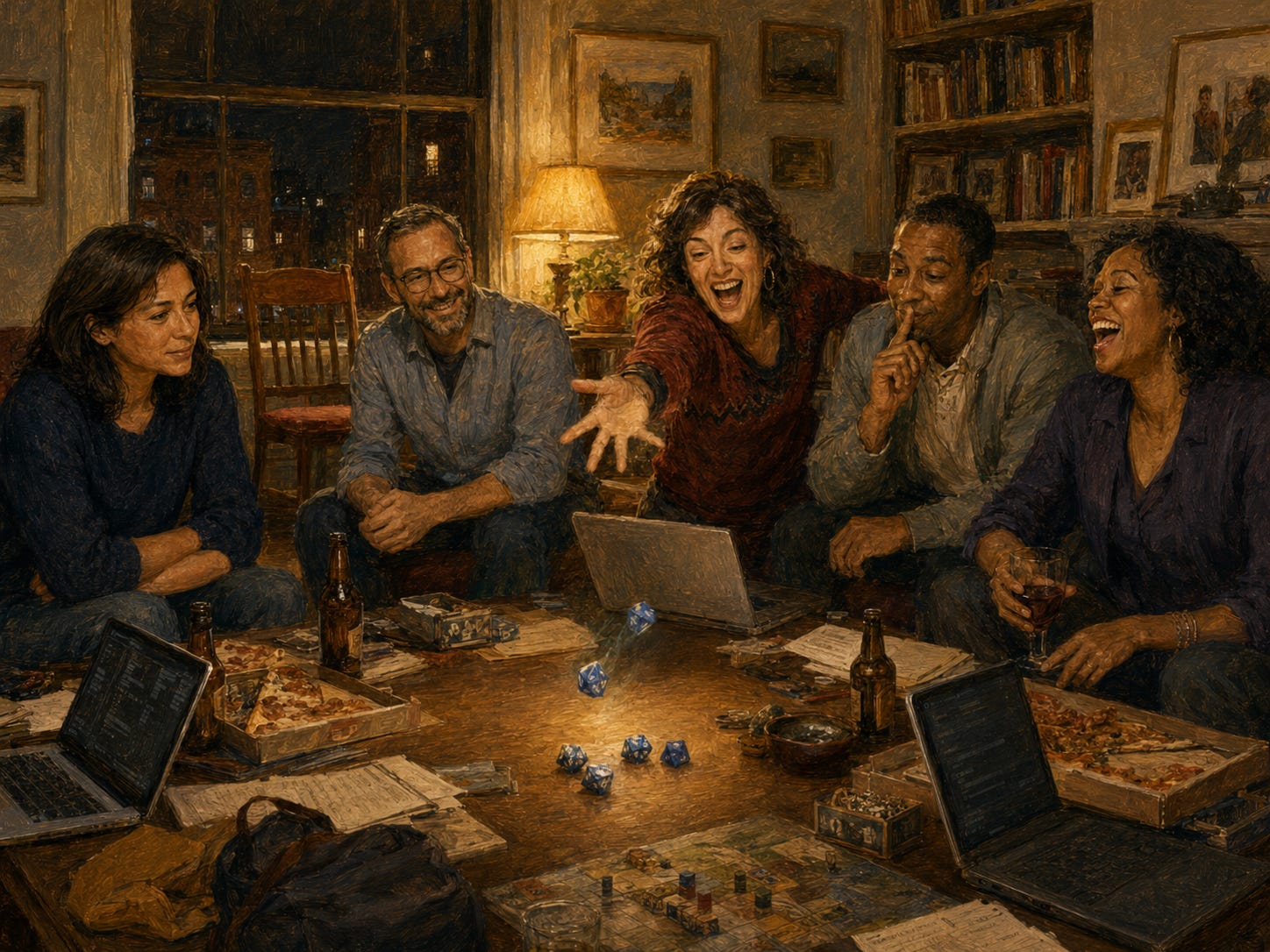
She sent everyone north. She lost the north front and most of her army with it, and the look on her face as the whole thing came apart was, by unanimous silent vote, the best thing any of them had seen all month: pure delight, the specific joy of a catastrophe you chose with your own hand, that no model would have signed off on and no agent could have wanted for you. The agents recorded the outcome without comment. Priya laughed so hard she had to put her drink down. Even Felix, mid-collapse himself, grinned like the host of something worth hosting.
It ended at a quarter to eleven, Felix conceding to Lina, who’d won half by accident and admitted it. They finished the pizza. They argued pleasantly about which Quest to grab at next month’s Jam: the food-pantry inventory thing Marta had her eye on, or the middle-school scheduling mess Priya swore was twenty minutes of real work hiding inside a year of meetings. Lina put the dice back in the bag. At the door she hugged Felix a little harder than the occasion called for, and he said “go home, betrayer,” and she went, up two flights, into the quiet.
Close
She poured a glass of water and stood at the counter, where the rain had stopped and the streetlight made the wet sidewalk shine.
Three rooms. Each had asked her to be a slightly different person, with a slightly different agent, under slightly different rules, and each had handed her the same question in a different envelope. When the preparing is free, what is the human for. In the morning the answer had been judgment with no name on it, the thing the dropdown couldn’t hold and her brother couldn’t picture, no less real for being unsayable, filed at last under Architect and meant. At six the answer had been sharper and worse: the human was the one who knew the brook and knew the man, the only thing in a leveled room that could tell a clean motion from a lie, and also, said a postdoc’s voice laying a fact down like a napkin, the one who could be wrong about the brook in ways the brook would take years to announce. And at half past eight the answer had been the dice: the human was the one allowed, by house rule, to do the unwise glorious thing on purpose, because being the kind of creature that could was the part no optimization would ever return to you, and someone had to keep the trapdoor open or there’d be no floor to choose to fall through.
The agents had done most of the work in all three rooms. The humans had done all of the deciding, and the deciding had been small, and it had cost. Theo’s empty chair. Her brother’s unanswered text. Felix’s only just. Priya’s curves, moving one way. The mug, the hat, the dice: three things you could close a hand around when a room got too smooth and too fast and too well-prepared, to remember which one of you was the human. She thought they were really the same object. She thought the three rooms were really, in their way, the same room. Which was the whole thing she’d been trying and failing to say to Ken, and the room had a door in it, and the door was new, and two buildings over a man preferred the room with no door, and she still couldn’t decide whether that was courage or surrender, and she was going to have to find out.
She washed the glass. The bid was due Friday. The co-op would break ground by fall. She would have to call Theo, or not, and she didn’t know which yet. Next month was the Jam at the old civic-tech space, and the month after that was game night at Sam and Priya’s, the first time they’d host as a unit, which Marta had already opened a side bet on.
She turned off the light. The dice were in the bag by the door, where she could reach them.
I conceived “Three Rooms” and wrote and edited it with assistance from Claude Code, Codex, and Grok CLI. Thanks to the teams behind those tools.
Postscript:
Lina Voss is the co-founder of a four-person firm with no name for what she does, working out of a converted machine shop near Kendall. She completed the law.MIT.edu summer intensive in 2026, the year before the work she’d trained for stopped existing. On the procurement portal she is listed as Lead of Record, Architect, which is not quite right and is the one she chose anyway.
The joint bid was awarded the contract in early May. First-month remediation came in at four hours against forty budgeted. The Lead of Record field still has no box for what she did to earn it.
Article 14 passed as amended; the co-op broke ground on the Meadow Brook site in October, and the twenty-five-year easement held through the November storms. In the spring the state revised its storm-recurrence tables, the way it now does every few years. Under the new curves the easement is still expected to hold. Expected. Friends of Meadow Brook reorganized as a watershed group and does, now, useful work.
Lina and Theo have not spoken. The plugin she installed for him is still wired into his overlay; she has thought, more than once, about how easy it would be to reach in and remove it, and has not, on the grounds that the tool was never the problem.
Game night two months on was at Sam and Priya’s. Theo’s chair was full again, occupied by one of Felix’s old coworkers, and the absence of a thing is not the same as its repair. Marta lost the side bet to Felix, who collected in pizza. The dice continue to be rolled about four times a year. Felix has still not gone to the Friday night with no agents in it. He keeps almost going.
Dazza, this is awesome!!
Whoa Dazza!
Excellent!!!