

We’re going to need a solid cognitive floor. I’ll explain that in a moment, but let’s start with optimism about the ceiling, because that is more to the point. The best AI models available today are extraordinary, and they are getting better at a pace that still surprises the people building them. Wherever a workflow, a decision, or a creative problem can absorb that capability and turn it into value, you should reach for the highest and best intelligence you can get; and pay the premium gladly, because the returns are real and growing. The frontier is where the spectacular views are. This post is not an argument against climbing to them.
It’s a thesis about what you build under them.
Because here is the catch. As organizations move core work onto autonomous agents, the frontier model stops being a productivity accessory and becomes load-bearing infrastructure. Yet it is load-bearing infrastructure that can be pulled out from under you; by export controls, policy shifts, or geopolitics; by a vendor deprecating a model or changing its terms; or, more quietly, by economics, as intelligence gets metered and agentic workloads consume compute at costs no flat-rate plan was built to sustain. Earlier this month (June 2026) a new leading open-weight model shipped the same week a frontier model was abruptly restricted under export controls. As all access was cut off by policy with no notice, a powerful open alternative became a credible fallback candidate. The specific event will date; the structural exposure and switching dynamics will not.
So you build a foundation. You establish a reliable baseline of machine intelligence the organization can rely on to keep essential operations running: a Cognitive Floor precisely so that you can build confidently and ambitiously upward on top of it. Nobody pours a strong foundation in order to live in the basement. They pour it so they can raise the spires. I think this floor is becoming a basic architectural axiom of the next era of the economy. And the floor keeps rising: as the technology improves, the minimum you can count on gets steadily more capable, which only makes building high safer and more rewarding.
The transition that created the need
By “the transition,” I mean the shift many organizations are already living through: from human-driven processes to autonomous, agent-first workflows that handle complete lifecycles — intake, planning, execution, exception handling, documentation, delivery — at high volume and high velocity. Humans move into elevated roles: they define tasks, specify outcomes, review outputs, approve consequential actions, and stand behind results before anything reaches customers, regulators, counterparties, or systems of record.
This is exactly where you want the best models working hardest, because the leverage is enormous. But it also changes the stakes of failure. Before transition, a model outage is a productivity disruption. After transition, it is an operating-model disruption. If agents are handling intake, execution, customer operations, documentation, software delivery, or compliance support, then model access has quietly become part of business continuity — and the governing question is no longer “which model performs best this month?” It is “what level of intelligence can we always afford, always access, and always govern?”
Why now
The pressure is arriving from two directions at once, and both are structural rather than passing.
The first is access. Dependence on a single closed-model provider is a single point of failure. Export controls, policy changes, geopolitical events, or simple outages can interrupt access with little warning, and for mission-critical or sensitive workflows, that can halt core business functions.
The second, quieter force is the metering of intelligence. Flat-rate subscriptions are giving way to usage-based billing, and agents consume far more compute than human chat ever did. We have already watched providers move heavy programmatic usage off subsidized flat rates and toward consumption-based, capacity-aware billing — reaching for those levers precisely because agentic demand outran what all-you-can-eat plans were designed to carry. The specific policies will keep changing, and some announced changes have already been walked back; the direction is what’s clear. Intelligence is increasingly priced as the scarce resource it is.
None of this is a reason to use the frontier less. It is a reason to make sure that when frontier access tightens, on price, capacity, policy, or availability, you have somewhere solid to stand.
What the Cognitive Floor is and is not
A Cognitive Floor is the minimum reliable intelligence capability you can count on to sustain essential AI-enabled operations when access to the frontier is lost, constrained, or uneconomic. At the bottom of the ladder sits the Floor of Cognition: the lowest level of machine intelligence the organization can reliably afford, access, govern, and operate under stress. Above it, the floor is also a launch pad — the stable base that lets you run aggressively at the frontier on the work that deserves it.
It is easiest to define by what it is not:
It is not the best model available, that’s what you reach for on top.
It is not simply the cheapest model that will answer. It is the lowest validated cognition layer that can safely sustain the workflow.
It is not merely “running AI locally.”
It is not a backup account with a second frontier vendor.
It is not a benchmark leaderboard.
It is a small resilience architecture: a validated combination of model capability, provider diversity, a deployment path you control, an evaluation harness, a governance layer, and a tested fallback procedure. Treating it as a single model is the most common mistake — and the one that leaves you exposed when that model, or the provider hosting it, has a bad day. And there is no single floor: your coding floor, your document-review floor, your customer-support floor, and your regulated-decision floor each have their own minimum requirements. Defining the floor means defining it per workflow.
A credible floor, whatever the workflow, should meet a few tests. It should support the essential agentic work, not just isolated chat or summarization. It should integrate with your existing agent frameworks, so fallback doesn’t mean rewriting agents from scratch. It should run on open, accessible models without the kind of licensing or policy strings that can be pulled without warning. It should hold up at production volume and over long horizons. And it should be economically viable at scale. If a candidate fails these, it isn’t a floor yet.
The economic mechanism: why the floor rises
It helps to see why this is structural rather than merely prudent. Demand for AI capability is not one curve; it is several stacked together. Some workloads justify frontier pricing and always will — that’s where you spend without flinching. Some justify a strong mid-tier model. But a large and growing class of workflows is highly elastic: the moment a cheaper substitute becomes good enough, those workloads move.
That movement happens at the crossover point — when an open-weight model becomes capable enough, cheap enough, and reliable enough to substitute for a closed model in a specific workflow. The crossover isn’t when an open model beats a frontier model in the abstract; it’s when it clears the bar for a defined job at a cost-and-reliability profile that changes the operating decision. Each workflow crosses on its own schedule.
This is why the floor keeps rising. Every few months, open-weight models clear the bar for another class of work that used to require the frontier. The set of workflows that must run on premium models shrinks; the set that can safely run on the floor grows — which frees premium budget to push the frontier harder on the work that genuinely needs it. If the trajectory continues, capabilities that feel frontier-class today will increasingly become part of tomorrow’s floor.
A snapshot, to make this concrete without dating the argument: as of mid-2026, models such as GLM-5.2 show why the floor is rising — long-context, open-weight systems with permissive licenses are becoming viable for serious agentic and coding workflows, the kind you can self-host and build on without asking permission. The model name will change quickly; the strategic point won’t. The specific model will change. The architectural requirement will not.
Intelligence as infrastructure you can build on
Step back far enough and a larger pattern appears. Open-weight models are beginning to create an intelligence infrastructure layer: a broadly accessible baseline of reasoning, coding, analysis, and automation that no single closed-model provider fully controls. The analogy is to public libraries and public roads — not because hosted inference is literally a public good (it runs on someone’s metered servers under someone’s license), but because a widely available baseline capability lets the whole system build on top of it without asking permission.
That has a consequence the defensive “insurance” framing misses. Once a baseline is reliable, you can build on it. Organizations can design entire operations — fulfillment, accounting, analysis, software delivery, customer operations, compliance — around a known, sustainable level of intelligence, rather than hoping frontier prices and access stay favorable indefinitely. The public-sector implication is even sharper: a government should not build essential citizen services on a capability that might become unaffordable or unavailable without warning. A public-sector Cognitive Floor is a continuity requirement for AI-enabled administration, not a nice-to-have.
The operating model: frontier, mezzanine, and floor
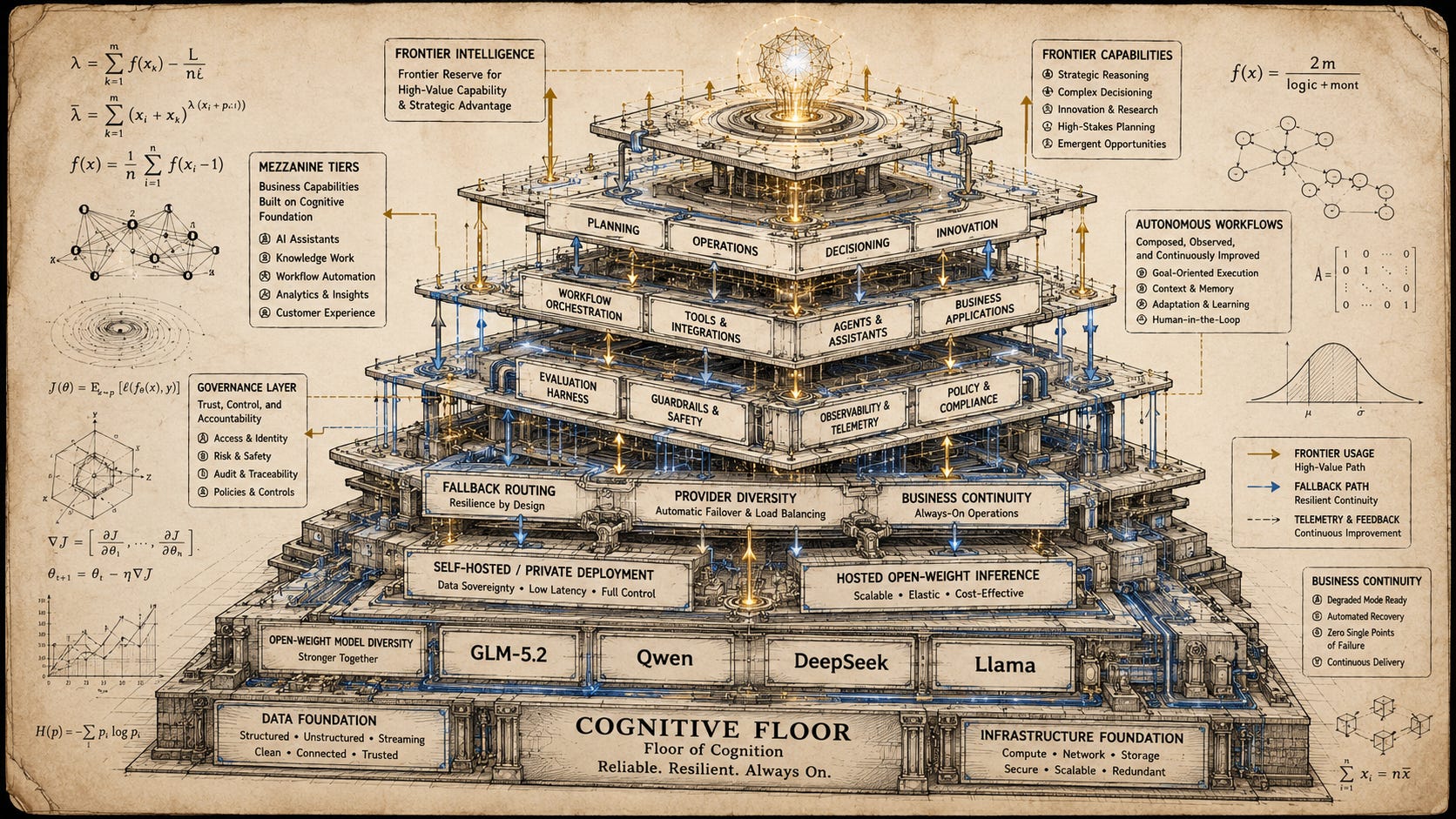
The floor is not the first step down from the frontier. Between the best available model and the minimum cognition that keeps the lights on, most organizations will want mezzanine levels — a ladder of validated step-down options, not a binary. A workable ladder looks like: frontier models for the highest-value, highest-stakes work; strong mid-tier or specialized models for important but less exceptional work; hosted open-weight models for validated high-volume workflows; multi-provider routing for resilience; and private or self-hosted deployment for the most continuity-sensitive workflows, with the Floor of Cognition beneath all of it.
The routing logic is simple to state. In normal conditions, send each workflow to the highest-value tier that earns its cost — and for the work where superior reasoning genuinely changes the outcome, that means the frontier, used affirmatively and without apology. Under constraint, step down through tested mezzanine levels. Under severe disruption, fall back to the floor that preserves essential operations.
Call the discipline behind this intelligence austerity if you like — though the name undersells it, because it is not pessimism and it is not anti-frontier. It is the deliberate allocation of scarce premium cognition. You maintain a frontier reserve: a protected budget and an explicit routing policy for the work that deserves the best available intelligence — major strategic decisions, high-stakes legal or compliance analysis, complex security incidents, sensitive communications, critical engineering architecture, the calls where being right is worth almost any price. The reserve is spent affirmatively, not grudgingly. The floor keeps the enterprise running so the reserve can be aimed where it matters most. That is a more ambitious posture than either “use the frontier everywhere” or “move everything to open models” — and a more honest one, because, as anyone who has run their own inference knows, the floor is not free.
Building your Cognitive Floor: a practical guide
Implementing a floor doesn’t require an all-or-nothing switch. The smartest approach is deliberate, tested redundancy.
1. Classify your workflows, and map their tiers. Identify which AI-enabled workflows are essential, sensitive, expensive, or operationally exposed; focus the floor first where failure creates material business, legal, or reputational risk. For each, define the tier map: the frontier model for maximum-value conditions, one or more mezzanine models for cost control or moderate constraint, a floor model and deployment path for continuity, and a human-escalation path for when the floor can’t safely finish the job.
2. Select candidate floor models per workflow. Choose open-weight models that plausibly clear the bar for each workflow. Evaluate beyond headline benchmarks: context length, tool-use reliability, output quality, license terms, latency, provider availability, and community adoption.
3. Use hosted providers first — but remember that hosted is a bridge, not the bunker. Hosted open-weight inference is the fastest, cheapest way to start testing, and migration friction is low: many providers expose endpoints compatible with the harness you already use. Think of it as the first mezzanine level — but note that hosting an open model on someone else’s cloud reduces model-vendor concentration without eliminating provider-availability risk. For continuity-sensitive or regulated workflows, preserve a path to self-hosting or private deployment, which is the strongest continuity posture.
4. Run parallel testing for at least one full operating cycle. Route the same workflows to both your primary model and the floor model. Compare completion quality, tool-call reliability, coherence over long horizons, human-correction rate, latency, failure modes, and cost. The floor is only real if it works inside your workflows — not on a leaderboard. The payoff is that when you do need to step down, it’s a smooth handoff rather than a cold start, because you’ve already proven the floor on real work.
5. Define fallback triggers and govern the floor. Establish the conditions — provider outage, cost thresholds, latency degradation, policy constraints — under which traffic steps down. Then govern it like the critical infrastructure it is: evaluation harnesses, quality thresholds, human-escalation paths, security and license review, cost monitoring, and periodic revalidation. A floor that has not been evaluated, monitored, and rehearsed is not a floor; it is an aspiration.
6. Maintain it honestly. Models, providers, prices, and tool behavior all change, and so will your workflows. And running parallel infrastructure is not free — you may set out to save on tokens and discover you’ve taken on maintenance, updates, security, and the people to run them, where the cost of humans can dwarf the cost of tokens. Hosted providers hide much of that overhead inside well-operationalized companies; bring it in-house and it becomes yours. Budget for it.
The strategic payoff
The Cognitive Floor turns model selection from a procurement question into a governance function — connecting architecture with business continuity, vendor risk, cost control, and data governance. The board-level questions become simple to ask: Which workflows now depend on AI, and which cannot pause? What’s the highest-value tier for each? What are the mezzanine step-downs? What’s the floor? Who owns testing, routing, governance, and revalidation?
But the deepest payoff is the one we started with. It turns a vulnerability into a strategic advantage. A strong foundation is what lets you build high: when you know the baseline you can always afford, always access, and always govern, you can reach for the frontier aggressively on the work that justifies it — and design bold, bespoke, intricate structures on top of your floor — without betting the whole enterprise on conditions you don’t control.
The winners in the agent-first era won’t be the organizations that blindly chase the newest model every week, nor the ones that reflexively retreat to the cheapest alternative. They’ll be the ones that use the frontier where it creates the greatest value, know their mezzanine step-downs cold, and stand on a Floor of Cognition they can rely on when conditions change. Even deciding “the floor isn’t for us right now” is legitimate — as long as it’s a deliberate, revisited choice rather than an assumption you never re-examine.
The floor is not the ceiling. It is the foundation. And the higher the frontier rises, the more valuable a solid foundation becomes. The time to build yours is before you need it.